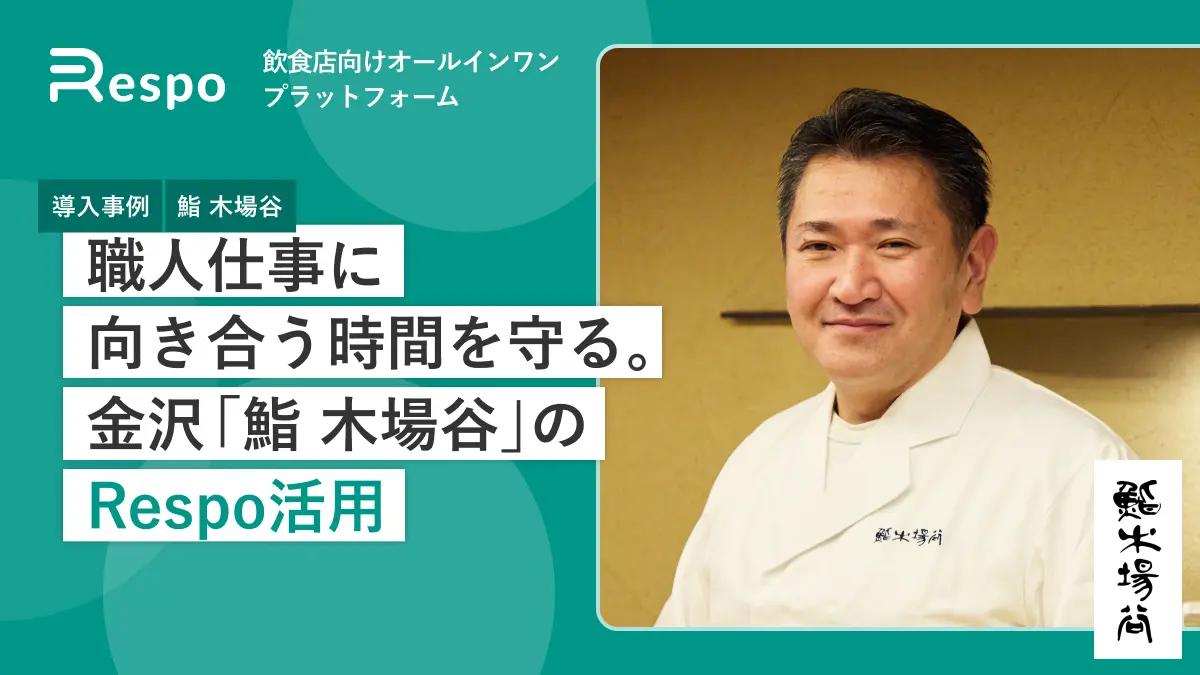
Sushi Kibatani is a sushi restaurant in Kanazawa where chef-owner Mitsuhiro Kibatani crafts sushi using fish from the Hokuriku region — primarily sourced from Toyama, Himi, and Shinminato — and the techniques of Edomae-style sushi. The restaurant welcomes a remarkably wide range of guests, from those in their 20s to their 80s, and in recent years, local, traveling, and overseas guests have come to visit in roughly equal proportions. At the same time, the restaurant had been facing on-site challenges: the operational burden of phone-based reservations during service, same-day and no-show cancellations, and information management with a paper reservation book. With Respo, reservation handling has been streamlined, cancellation prevention strengthened, and reservation and guest information centralized — establishing a foundation that creates the time the restaurant truly wants to dedicate to cooking and hospitality.
Challenges Before Adopting Respo
Sushi Kibatani had been facing the following on-site challenges.
■ The operational burden of phone-based reservations during service
-
Each call required back-and-forth conversation — "That time is fully booked," "How about this time instead?" — and it often took considerable time to confirm a single reservation
-
During service, the chef frequently had to stop preparation or guest service to answer the phone
-
Managing reservations solely with a handwritten paper book added significant confirmation work and required constant attention to avoid mistakes
■ Lost opportunities from turning guests away, and same-day and no-show cancellations
-
When the requested date was already full, guests sometimes had to be turned away on the spot. There was no guarantee that such guests would book again later, which represented lost opportunities for the restaurant
-
Same-day and no-show cancellations were also a burden — with a limited number of seats, even a single cancellation had a significant impact on the restaurant
Key Features of Respo
"Respo" is an all-in-one platform for restaurants provided by Hello Inc. It brings reservation book, channel manager, POS, payment terminals, and mobile ordering together on a single platform, and can be flexibly combined to match each restaurant's scale and business format.
■ What Respo Offers
-
Reservation book: Integrates with multiple reservation platforms, eliminating manual transcription from each platform
-
Channel manager: Centrally manages inventory across the restaurant's own site and other reservation platforms
-
POS / Payment terminals: Complete checkout and payment in a single device, streamlining store operations
-
Mobile ordering: Enables guests to order from their smartphone or tablet, reducing wait times
-
Guest information management: Accumulates visit history, preferences, allergy information, and more, supporting tailored service for returning guests
Outcomes After Adopting Respo
■ Outcome 1: Freed from phone-based reservation handling, creating time to focus on the work at hand
With reservation availability now visible to guests, they can confirm openings and complete their bookings on their own. This has greatly reduced the frequency of "scheduling adjustments over the phone" and "turning guests away when fully booked." During service, the chef is no longer pulled away by phone calls and can focus on preparation, guest service, and the work in front of him — easing the psychological burden as well.
■ Outcome 2: Suppressing cancellations and reliably collecting cancellation fees — eliminating lost revenue
With Respo's cancellation fee pre-authorization mechanism, no-show cancellations have decreased significantly. When cancellations do occur, the restaurant now has a system in place to reliably collect cancellation fees that previously went unrecovered, protecting revenue opportunities. For a sushi restaurant with limited seating, reducing per-reservation opportunity loss brings considerable peace of mind on the business side.
■ Outcome 3: Centralized reservation and guest information, enabling focus on cooking and hospitality
Reservation and guest information, once scattered across paper records, are now managed in one place — making pre-visit preparation significantly smoother. For the growing number of overseas guests in particular, organizing and sharing advance information has become much easier. Internal information sharing among staff has also improved, reducing mismatches and missed confirmations. Service for returning guests has become more attentive, and the time once consumed by information management is now dedicated to what truly matters: the cooking and hospitality the team wants to focus on.
Comments from Mitsuhiro Kibatani, Chef-Owner of Sushi Kibatani
We received the following comments from chef-owner Mitsuhiro Kibatani.
"Reservations are now organized automatically, which has greatly eased my mental load. What I'm most grateful for is no longer having to tell guests 'I'm sorry, that time is fully booked' every time the phone rings, as we used to under the old phone-based system."
── Mitsuhiro Kibatani, Chef-Owner, Sushi Kibatani
"Building relationships with our guests is essential to this business. Reducing the burden of information management means we can devote more time to what we truly want to focus on — the cooking and hospitality. Whenever I share a request for improvement, the team genuinely listens, and I trust they will keep reflecting voices from the field to make the system even easier to use."
── Mitsuhiro Kibatani, Chef-Owner, Sushi Kibatani
Comment from Yuki Hariguchi, Representative Director, Hello Inc.
"Sushi Kibatani is one of the restaurants we hold in the deepest respect — a place where each fish from Toyama, Himi, and Shinminato is treated with the utmost care, from the application of salt to the aging process, with the aim of delivering it to guests in its finest form. As Mitsuhiro Kibatani has said, 'It's the small accumulations that ultimately shape the impression of a single piece of sushi.' Craftsmanship like his is honed only when there is time to focus on each detail, one by one.
We believe that Respo should be more than a tool for efficiency — it should be a foundation that protects the time restaurants truly cherish. We will continue to evolve our product by learning from voices on the ground, so that the time Sushi Kibatani devotes to cooking and hospitality can become ever more meaningful."
About the Case Study Article
The full story has been published on the official Respo website as an interview with Sushi Kibatani. We invite you to read it.
▶ Case Study Article: "Protecting the Time to Focus on Craftsmanship: How Sushi Kibatani in Kanazawa Uses Respo"

