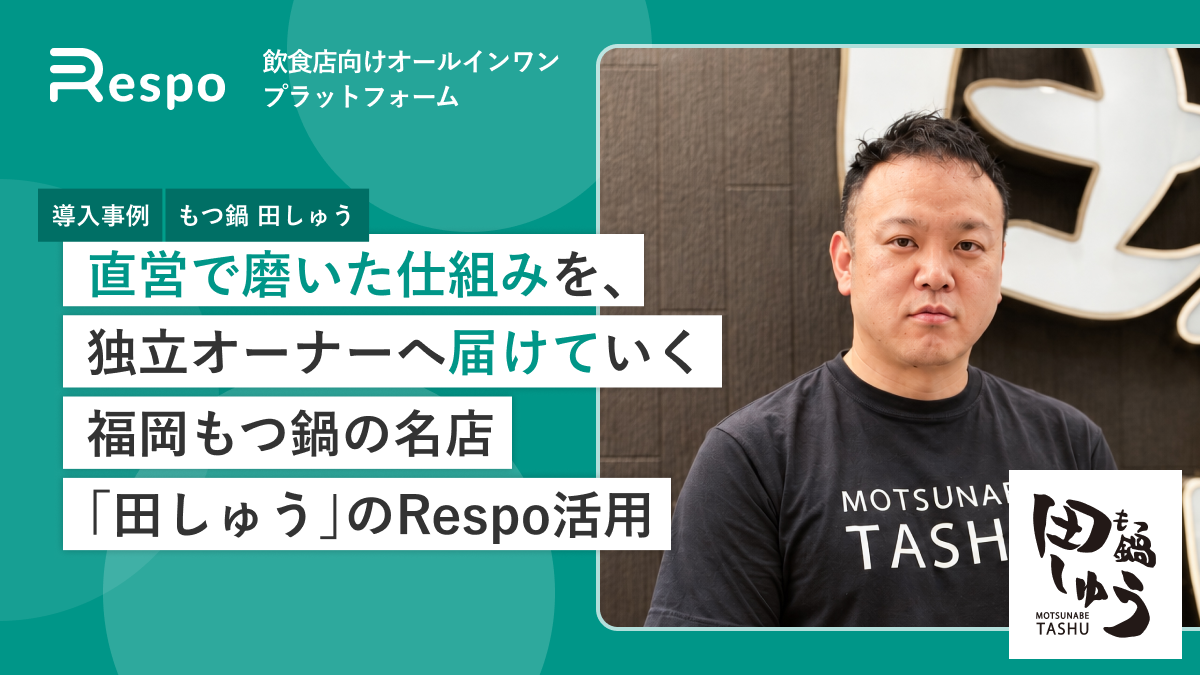
Tashu is a celebrated motsu nabe restaurant group born in Fukuoka’s Hakata district, with restaurants spanning from Nagoya all the way down to Kagoshima. While the group has expanded its network through its distinctive “noren-wake” independence-support program — a system through which staff can one day become presidents of their own restaurants — it had been facing persistent on-the-floor challenges, including operational strain from running POS, reservations, timekeeping, and order management on separate systems, as well as lost reservation opportunities driven by growing inbound tourist demand. With the adoption of Respo, Tashu has set out to realize “a long-term partnership that goes beyond reservation management and supports the future of the group as a whole.”
Challenges Before Adopting Respo
The Tashu Group was facing the following operational challenges:
■ Scattered restaurant-operation systems
-
POS, reservations, timekeeping, and order management each ran on separate systems, creating significant operational overhead
-
Because the systems were fragmented, the information that could be gathered from them was also limited, and guest data was not being fully leveraged
-
With the large-scale system they had been using, costs ballooned the more features were added — making it difficult to take the first step toward unification
■ Lost reservation opportunities driven by rising inbound demand
-
In the Hakata area, international guests — primarily from Korea and Taiwan — account for approximately 40% of guests
-
At Fukuoka Daimyo Honten, the restaurant was in a situation where it had to turn away around 2,000 guests per month due to being fully booked
-
There was a wide gap between the group’s wish to take seriously the fact that “a guest went to the trouble of coming to us, but we weren’t able to seat them because we were full” and the reality on the ground
■ The need for a partner relationship built on “building the future together”
-
The group was looking for a system provider who could go beyond simply handing over a tool — a provider who could share their vision
-
To deliver a working system to independent owners through the “noren-wake” program, a partner at the headquarters level who could serve as a core pillar was indispensable
Expected Impact of Adopting Respo
■ Impact 1: Unifying scattered restaurant-operation systems
By consolidating onto Respo the restaurant-operation functions that had previously run on separate systems, the group expects to reduce operational overhead and bring together information that had been fragmented. As this unification progresses, the scope for leveraging guest data is also expected to expand significantly.
■ Impact 2: Moving toward resolving the “forced to turn away” opportunity loss
Behind the situation of having to turn away around 2,000 guests per month lies the physical constraint of seat capacity. To address this challenge, the Tashu Group has a new restaurant opening in fall 2026, and Respo will serve as the operating foundation that supports the launch of that new restaurant.
In parallel, at existing restaurants the group aims to minimize opportunity loss in the following ways:
-
Reducing losses from cancellations and open seats: When a cancellation occurs, the follower-notification feature quickly delivers open-seat information to followers, connecting the restaurant with guests who otherwise might have missed the chance to visit
-
Reducing missed international reservations: With multilingual reservation pages and AI phone handling, the restaurant builds a foundation for welcoming inbound guests who previously couldn’t complete a reservation due to language barriers
-
Operational efficiency through consolidation: Unifying systems shortens the operational time required on the floor, freeing up more time for reservation handling and guest interactions
■ Impact 3: Delivering a refined system to future independent owners
The plan is to fully master Respo at directly-operated restaurants and build out a standard operating model for the Tashu Group as a whole — and then to deliver that completed system, as-is, to owners who go independent through the “noren-wake” program. Respo will serve as the core of the headquarters’ effort to reduce the initial risk independent owners face and provide an environment where they can take on a restaurant of their own with peace of mind.
■ Impact 4: A long-term partnership built on shared vision
The decisive factor for the Tashu Group — which had been seeking a long-term relationship that goes beyond “handing over a tool and walking away” — was Respo’s team posture of engaging deeply enough to understand “the future of Tashu as a company.” Even after rollout, a partnership has begun in which Respo walks alongside the group with flexibility across a wide range of areas, including promotion and consultations on new features.
A Message from Mr. Yasuaki Sakamoto, Tashu Group
What ultimately decided it for us was the “passion” of the people on the Respo team. Of course we compared functionality and cost, but what left a bigger impression on me was that they went all the way to asking “How do you envision the future of Tashu as a company?” It wasn’t about simply providing a tool — they wanted to understand our vision and then build something together with us. That posture came through strongly.
First, we want to fully master Respo at our directly-operated restaurants and build out a standard operating model for the Tashu Group as a whole. On top of that, we want to deliver the completed system to the “noren-wake” owners who go on to open their own restaurants — that is, honestly, the biggest thing we’re aiming for with this adoption. We’re counting on Respo to serve as the core partner in that effort.
A Message from Yuki Hariguchi, CEO, Hello Inc.
The Tashu Group is a truly unique organization that has expanded its network through its distinctive “noren-wake” program, where staff can one day become presidents of their own restaurants. When Mr. Sakamoto shared with us his wish to “deliver the system refined at directly-operated restaurants to future independent owners,” it struck us strongly that Respo should aim to function not merely as a restaurant-operation tool, but as a “standard operating foundation” for the group as a whole. In an era when the cost of opening a restaurant keeps rising year by year, being able to build — as the headquarters — a system that each independent owner can rely on from day one is itself a meaningful effort. For Respo to serve as the partner enabling that is deeply significant to us as well. The flow that the Tashu Group envisions — “refine it at directly-operated restaurants, then deliver it to future owners” — is one that Respo will stand by firmly as the core infrastructure.
Read the Full Interview
The full interview with Mr. Sakamoto is available on the Respo website. We invite you to take a look for a deeper view into the thinking behind the “noren-wake” program and the group’s vision for delivering a refined system to future owners.
▼ Case Study
“Delivering a Proven System to Future Independent Owners ── How Tashu, the Celebrated Hakata Motsu Nabe Restaurant, Puts Respo to Work”

