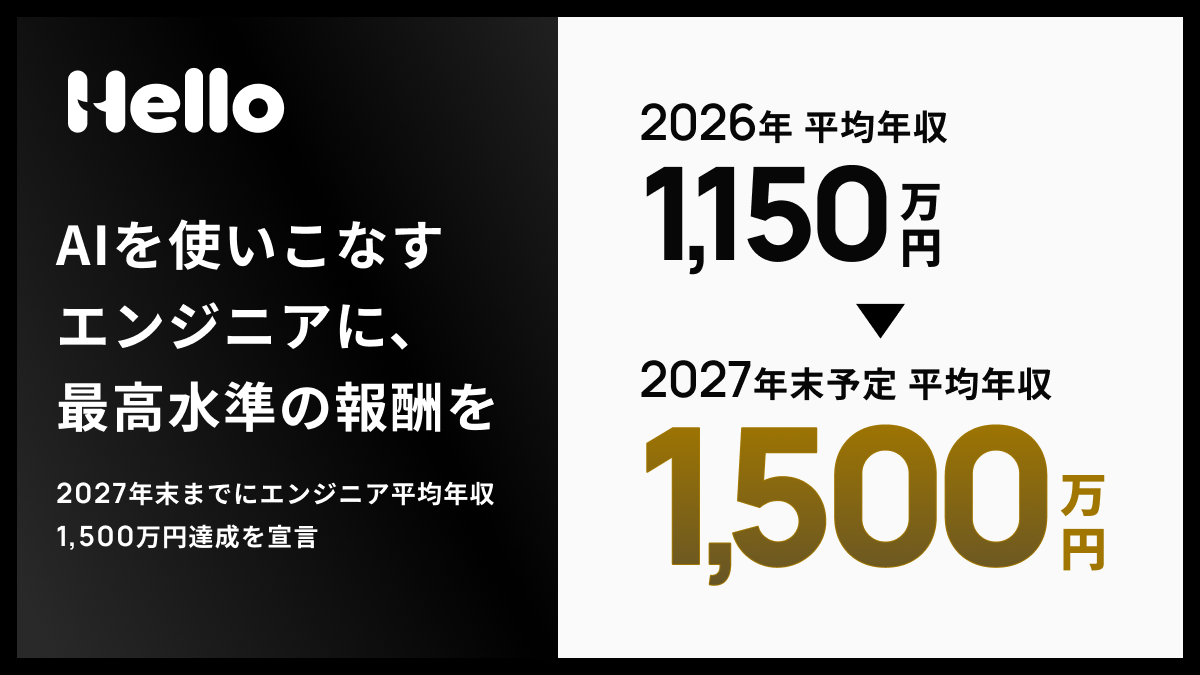
Hello Inc. is pleased to announce that, with the goal of raising the average annual salary in its engineering organization to ¥15 million by the end of 2027, it will roll out a new compensation system and expand its AI utilization support program starting June 2026.
Hello's current engineering average annual salary is ¥11.5 million. AI is already used daily across the entire engineering organization as a "standard part of the company's toolkit." Building on that foundation, this round of institutional renewal positions Hello as a lean, elite engineering organization targeting industry-leading compensation levels. Regardless of whether engineers are new graduates or mid-career hires, compensation will be determined based on role, skill, and performance — not tenure or career history. Together with the continuation and expansion of AI tool subsidies and the integration of AI utilization into performance evaluation, Hello will further accelerate AI adoption across the entire organization.
Background and Objectives
With the rapid advancement of generative AI, engineering productivity and the skill sets it demands are changing at a pace unlike anything in recent years. Hello regards this shift as a growth opportunity for both the organization and the individual, and has crystallized the following three principles as management policy:
-
Company-wide rollout of development and operational processes built on the premise of AI
-
Returning the added value generated through AI utilization to individuals via the compensation and grading systems
-
Fair evaluation based on role, skill, and results — not tenure or career history
In line with these principles, Hello is renewing the compensation system for its engineering organization and expanding its AI utilization support program.
Hello's Position: A "Lean, Elite" Organization Built on Selective Hiring
Hello's commitment to maintaining hiring standards and operating as a "lean, elite" team is not for the sake of achieving high compensation. The primary reason is to avoid a situation in which hires who fall short of the required bar increase the burden on other engineers and drag down the output of the organization as a whole.
By continuing to rigorously evaluate each individual's technical capability and problem-solving ability at the hiring stage, we have preserved an environment where every member can focus on the high-difficulty problems they should be tackling. As a result, the value generated per engineer remains stable at a high level, and the structural foundation for offering commensurate compensation is in place.
-
We do not lower the hiring bar. For the roles we need to fill, we prioritize the quality of the match — even if it takes time.
-
We keep individual autonomy and scope of impact broad. We have built an environment in which high-level engineers stimulate one another daily and accelerate each other's technical growth.
-
We redirect AI-freed capacity to high-difficulty problems. Time created by automation and efficiency gains is reinvested into new business, platform improvement, and R&D.
This compensation increase is the natural outcome of that lean-and-elite approach, and it is a statement of Hello's intent to become the first company that comes to mind for top engineers — both in working environment and in compensation.
Overview of the New Compensation System
For engineering roles, Hello will introduce a new compensation system built on the following two pillars:
| Item | Details |
| ---------- | ---------- |
| Salary Range | The current average annual salary across all engineering roles is approximately ¥11.5 million. The goal is to raise the average to ¥15 million by the end of 2027. Regardless of whether engineers are new graduates or mid-career hires, salary is determined at the time of joining based on skill, experience, and role within the defined range. For Senior / Principal Engineer-level positions, offers exceeding ¥20 million annually are already available. |
| Grade and Evaluation | A job-specific grading system has been introduced. Evaluation is based on three axes: "technical scope of impact," "business impact," and "productivity enabled by AI and automation." Promotions and raises are determined by role and results at each grade — not by tenure or length of service. As a tracked result, an average raise of 9.2% has been achieved after six months. |
Overview of the AI Utilization Support Program
To standardize AI utilization across the organization — rather than leaving it to individuals — as a precondition for productivity, Hello operates the following systems and culture. What sets it apart is not merely supplying tools, but designing work on the premise that the organization "uses AI to the fullest," and operating it as a culture in which engineers actively give each other feedback.
(1) Tool Provision
- AI Tool Subsidies: For all engineers, the monthly subscription fees for business-use generative AI and coding-assistance AI — including Claude Code and Codex — are fully covered by the company.
(2) Organization-Level AI Utilization Tracking
-
Continuous Usage Tracking: Using the AI usage aggregation service "supateam," the organization's overall token usage is shared on Slack on a weekly basis. The team continuously monitors whether AI adoption is progressing as an organization.
-
Usage Targets: As an organization, target values are set for AI token usage. Work is designed on the premise of "using AI to the fullest."
(3) Feedback and Knowledge Sharing
-
Support from AI-Proficient Engineers: Engineers who are highly skilled in AI utilization support other members in adopting effective usage patterns. Improvement suggestions are made daily from the perspective of, "Could this work be made more efficient with AI?"
-
Slack Sharing of AI Use Cases: AI use cases, prompts, and workflows that emerge in day-to-day work are shared on Slack as they happen.
-
Immediate Knowledge Sharing: A culture is firmly in place in which engineers routinely gather and share information on new AI services, new features, and relevant research.
(4) Incorporation into Evaluation
- AI Utilization in Grade Evaluation: "How much productivity was improved through AI utilization" is explicitly defined as one component of grade evaluation. Engineers are encouraged to redirect the surplus time created by AI toward higher-difficulty work.
Comment from Hello Inc. CTO, Kazato Sugimoto
"Rather than simply 'writing code with AI,' Hello fairly evaluates and rewards — with top-tier compensation — engineers who 'engineer AI itself to tackle higher-value problems.' We are excited to work with people who are serious about engineering, in a team where a small, elite group of humans leverages a multitude of AIs to deliver results."
In Closing
In conjunction with this announcement, we have prepared the following touchpoints for engineer recruitment:
- Casual Interviews: Year-round, via our recruitment site (https://open.talentio.com/r/1/c/hello/pages/80664). We're happy to answer your questions 1-on-1 about our tech stack, working style, and compensation.

